
Statesboro Resident Record Coverage
Each record in a residents directory answers one narrow question. Bulloch County's property roll names the owner of record, not every occupant in a home. Court dockets show that a person was a party to a case. They do not show that each claim held up. Vital records confirm an event under access rules. State business and license indexes tie a person to a public filing or credential.
| Record | What It Confirms | Where | Access |
|---|---|---|---|
| Property parcel | Owner, mailing and situs addresses, deed pointer | Bulloch qPublic | Free search |
| Deed index | Party role, filing date, land reference | GSCCCA or clerk | Index or free clerk terminal; images may cost |
| Court docket | Party role, case course, disposition when entered | Bulloch courts and provider | Public unless sealed; account may be needed |
| Vital event | Birth, death, marriage, or divorce fact | Health, Probate, DPH, or Superior Court | Eligibility and fees vary |
| Business or license | Public filing role or credential status | Georgia SOS | Free index |
| Estate file | Decedent, representative, and public heir clues | Bulloch Probate Court | Counter or participating provider |
Start with the record tied to what you already know. An address points to qPublic. A case number points to the court. A company name belongs in the corporations index. Matching record type to starting fact keeps a Statesboro resident lookup tight. It also cuts down on same-name errors.
Build a Statesboro Identity Match
Name plus city is a weak match in Statesboro. Georgia Southern brings a large, fast-changing population, and many local families go back generations with shared surnames. Keep the details intact. Suffixes, initials, maiden names, and spelling variants all matter. Insist on two independent links, like a parcel plus its deed book and page, or a business control number plus the registered-agent filing. A mailing address that differs from a parcel's situs can help, though it may point to an agent or a business rather than a home.
- Search the Bulloch qPublic property roll by owner name. Record the parcel, situs, mailing address, and deed reference.
- Use the deed pointer in the official GSCCCA index. Match the person, party role, filing date, and legal description rather than the name alone.
- Check a court, business, license, probate, or vital source that fits the question. Note every role and date.
- Request the underlying document or certified copy from its custodian if the result must be relied upon.
The two-record method takes longer than taking the first hit. It pays off by separating people who share a surname. It also stops a tax-mail destination from being mistaken for where someone actually lives.
Note: A homestead indicator supports owner occupancy for a qualifying owner and tax year. However, it does not list every household member.
Confirming Statesboro Court Names
No single search covers every Statesboro court name. Bulloch Superior, State, Magistrate, Probate, Juvenile, and Statesboro Municipal courts each keep their own records. The Georgia court e-access directory sends Bulloch State and Superior cases to a provider. You need an account there, and coverage runs unevenly. Certified copies call for the local clerk. Archived paper or microfilm, and public files that never made it online, stay with the clerk too. For those materials the clerk remains the definitive source. A resident lookup through the courts therefore usually ends at the clerk's counter.
| Search field | How it narrows a match |
|---|---|
| Court and division | Separates Bulloch Superior, State, and other jurisdictions |
| Last or business name | Finds party entries; partial matching varies |
| First and middle name | Reduces common-name collisions |
| Case number | Opens a known matter directly |
| Filed date and case type | Limits results to the relevant span and category |
A court result can carry a lot of detail. Case number, court, party names, roles, filing date, type, and status all appear when entered. Events, attorneys, and disposition show up too. Remember that it is still an index. Plaintiff, defendant, petitioner, respondent, decedent, executor, and attorney are distinct roles. Reading them correctly matters. The Georgia court data and records page shows the official route into that system.

The state directory entry point appears on the official page itself. A missing Bulloch file is a different problem. Contact the Clerk of Superior Court at 20 Siebald Street, or send a focused request with the name and case number.
Certified Statesboro Lookup Results
A screen result helps you spot a record. It is not the record itself. Certified copies come straight from the Bulloch clerk, who takes in-person, mail, and email requests for public Superior, State, and Juvenile material. An email to clerkinfo@bullochcounty.net should carry the name, the case number, and requester contact details. The office states a three-to-five-business-day process. Mailed civil-copy requests also need payment and a self-addressed stamped envelope.
- Docket
- A dated list of filings and events in a court case.
- Index
- A finding tool with names and record keys. It may not include document images.
- Image
- A scan of the filed document, which may reveal more detail and lawful redactions.
- Certified copy
- A copy authenticated by the custodian for uses that require official proof.
A plain copy from the clerk runs $0.50, and a certified copy costs $2.50. Those posted amounts apply per request, so ask the clerk how a multi-page file is priced before you order. Courts that take part in electronic certification also accept GSCCCA eCertification.
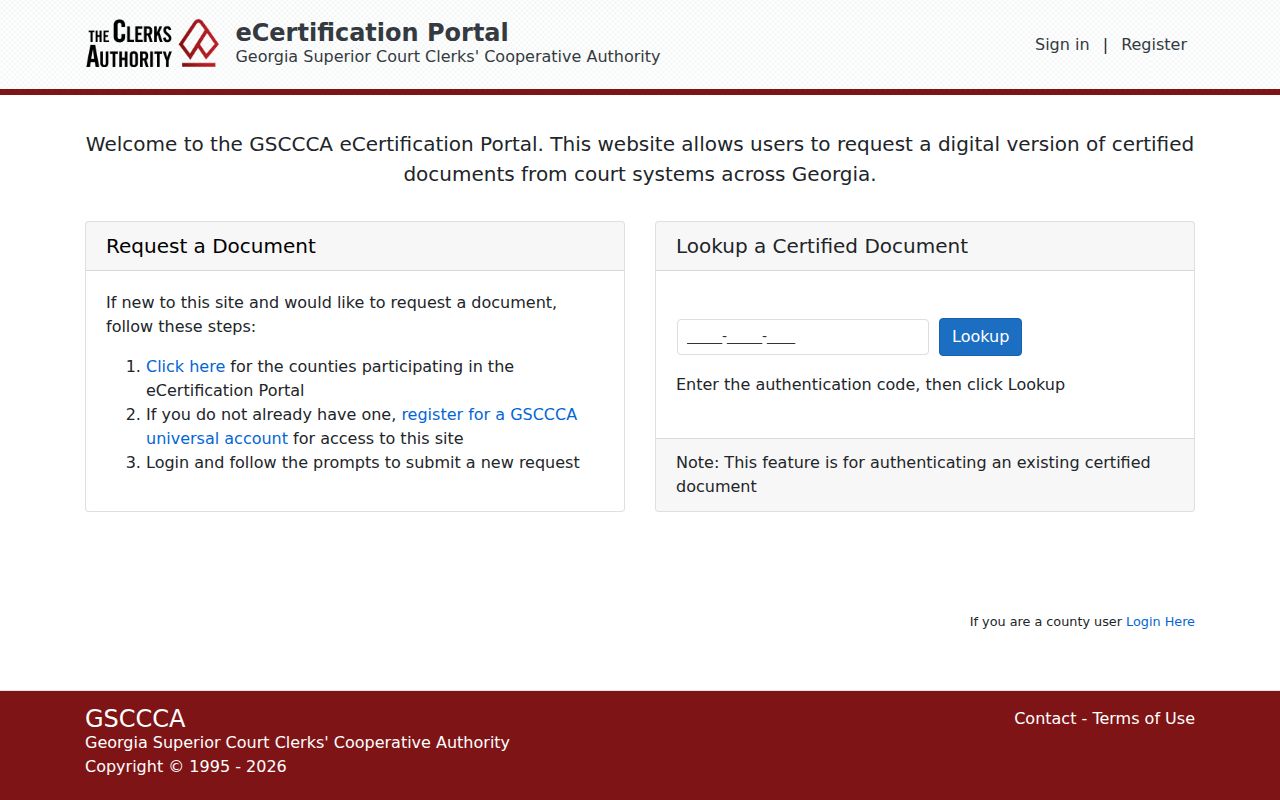
The official portal shows the difference between an online certification and a plain index hit. Fees and availability depend on the participating court and the item requested.
Statesboro Vital Record Routes
Vital records split along separate routes. Birth, death, marriage, and divorce each answer to a different office. The Bulloch Health Department and Georgia DPH issue eligible birth and death certificates, while Bulloch Probate Court handles local marriage licenses and copies. Divorce decrees stay with Superior Court, and DPH verification covers only its stated state span. A resident lookup works best when the event type picks the office before you order anything.
Birth certificates are confidential under O.C.G.A. §31-10-25, limited to the registrant, named family members, guardians, or legal representatives with proof. Death records are public, though protected fields get redacted and certified service follows requester rules. Current state fees run $25 for a first birth or death certificate and $10 for a state marriage record, with lower stated charges for added copies.
Georgia-born adoptees age 18 or older have a lawful route under Andee's Law, effective July 1, 2025, to request an uncertified original pre-adoption birth certificate. That process does not turn current birth files into a public name index. Genealogy access changes only after the archive clocks set by state law run out.
Finding Statesboro Heirs Lawfully
Probate records and obituaries are the lawful route for estate work or family history. They tie a late owner to living kin. A public Probate Court docket names the decedent, the petition date, and the personal representative. Filings may list heirs or addresses. Guardianship and adoption files stay sealed. Start from a death date or parcel fact. Then set the estate filing beside an obituary or cemetery record, and see where they agree.
Eastside Cemetery offers a clue most people miss. City Engineering keeps the lot purchaser's name plus a section, block, and lot reference. The buyer is not always the person buried there. So confirm with a death record, an obituary, or a stone transcription. Library newspaper microfilm reaching back to 1899 can surface family notices the current indexes skip.
That is a practical human use for a Statesboro resident lookup. It joins a public estate record to an heir, without treating a shared name as proof.
Checking Statesboro Public Roles
A business or professional fact can split two people who share a name. The Georgia Corporations Division search takes a business name, control number, registered-agent name, or officer name. It returns entity status, formation details, the principal office, agent address, and filings. The Georgia professional-license search works from board, license type, license number, name, city, and state. It returns public credential facts.
Statesboro's occupation-tax register adds local color: a business, its license, address, and date. The city publishes no online index. Ask the City Clerk or the Tax and Business License Department for the register it already keeps. Do this rather than requesting a new report. Georgia Southern's staff directory lists public work contacts only. It is not a private resident roll.
Use these role records as cross-checks. A registered-agent address or public office contact never proves a home address.
Another Statesboro Name Clue
The Georgia DOR unclaimed-property search runs a free name search with an optional city filter. A hit can hint at an old name-and-place link. It is not proof of a current address. Claiming requires identity and ownership support, estate and business claims need extra proof, and most paid claims take about 30 days, some longer.
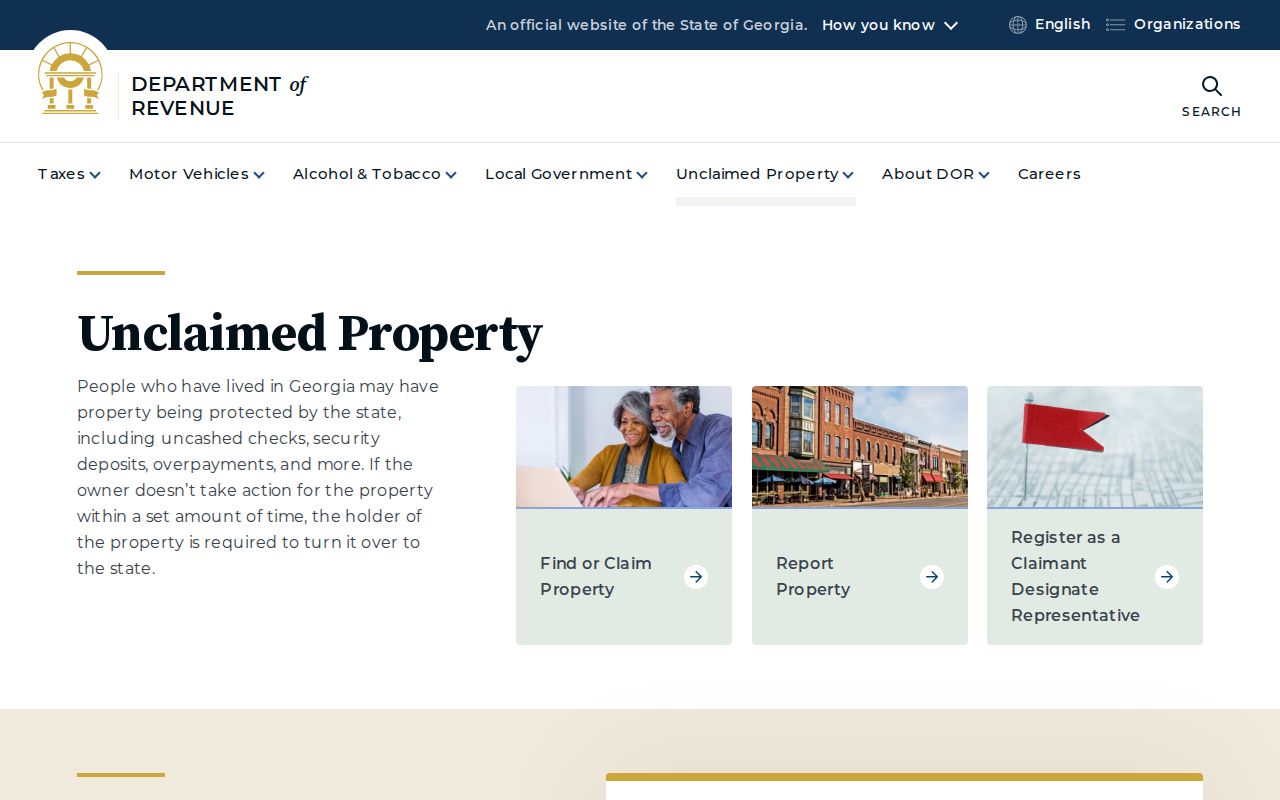
The image shows the official state entry, not a commercial people finder. Treat a match as a lead to confirm against a parcel, filing, or other source.
When Statesboro Portals Fail
An online gap does not mean the record is closed. Call the right office. Ask about a public terminal or older index books. You can also send a narrow Georgia Open Records Act request. A strong request names the custodian. It should identify the existing record, a name or address, the department, and a date span. Georgia agencies must respond within three business days. That answer may be a production schedule and cost rather than the record itself.
No law forces an agency to build a resident directory or do research for you. For city files, serve Statesboro's designated officer. Channels include the online form, email, fax, hand delivery, certified mail, or statutory overnight delivery. County court files go through the clerk's stated copy channels. The right custodian can also explain sealing, redaction, or correction.
Statesboro Resident Lookup Limits
Some official trails end by design. VoteSafe shields registered voters under protective orders or in family-violence shelters. Birth certificates, juvenile and adoption files, sealed court material, protected identifiers, motor-vehicle data, utility accounts, and private member lists stay closed. Combining other records does not open them. My Voter Page is an authenticated self-lookup, not a public street directory.
O.C.G.A. §50-18-72 permits redaction of Social Security numbers. It also covers medical and financial facts, a mother's birth name, parts of birth dates, and qualifying home details. Ask the source custodian to correct or lawfully redact its own file. Never rebuild a protected address from fragments.
Lawful use. Use a Statesboro resident lookup only for lawful personal research. Never use public information to stalk, harass, threaten, or intimidate anyone.